

Federico Zeri Distinguished Scholar Award
Italy
Number of recipients
In addition to being a prestigious academic exchange program, the Fulbright Program is designed to expand and strengthen relationships between the people of the United States and citizens of other nations and to promote international understanding and cooperation. To support this mission, Fulbright Scholars may be asked to give public talks, mentor students, and otherwise engage with the host community, in addition to their primary activities.
Teaching/Research Grants: Fulbright Scholars will teach or teach/conduct research in their area of specialization. Teaching should preferably, but not exclusively, be at the graduate level.
Other activities: Fulbright Scholars are strongly encouraged to engage in their host institution's ongoing work. They may be invited to contribute to curriculum, program, and faculty development, and may also have opportunities to lead seminars and workshops.
Italian universities, research centers, foundations, museums, academies, AFAM (Alta Formazione Artistica, Musicale e Coreutica, https://www.mur.gov.it/it/aree-tematiche/afam), or other appropriate Italian institutions. Affiliation with an institution in Southern Italy is encouraged.
A listing of Italian universities and access to their homepages can be found at https://cercauniversita.cineca.it, https://www.universitaly.it
Grants may begin any time after October 1, 2027, and should be completed by June 30, 2028. Grant dates must be arranged directly with the host institution and stated in the letter of invitation submitted with the application. Should the plans of the grantee or the host institution change, the grant dates may be amended at a later stage. Grantees who require a longer stay may extend their visit, provided that the total duration does not exceed five months. While the Commission will support the study visa application for the extended period, no additional Fulbright stipend will be provided for the extension.
Cultural Heritage is an interdisciplinary field that includes:
- Humanities: History, Art History, Archaeology, Anthropology, Classical Studies, Philology
- Conservation and Restoration: Conservation Science, Art Conservation, Architectural Conservation, Heritage Conservation
- Social Sciences: Sociology, Human Geography, Heritage Management, Cultural Policy Studies
- Architecture, Landscape, and Urban Studies: Architecture, Urban Planning, Landscape Architecture
- Museum and Archival Studies: Museum Studies, Archival Science, Library and Information Science
- Science and Technology: Materials Science, Digital Humanities, Geographic Information Systems, Remote Sensing.
This award offers a high degree of flexibility, enabling applicants to choose their activities, preferred timeframe, and host institution.
All applicants must meet the Program eligibility requirements (click to review the requirements).
Candidates must arrange their affiliation and include a letter of invitation from the host institution in support of their candidacy, indicating the dates of their grants.
Italian language fluency may be required for teaching, depending on the host institution's preference. However, based on experience, most scholars are asked to teach in English. Conversational Italian is helpful to engage more fully with the local community, even for those who will teach in English.
Useful links with information about the Italian academic system can be found at the CIMEA website https://www.cimea.it/EN/ and the website https://www.universitaly.it/
Information on Italian museums:
https://cultura.gov.it/evento/musei-italiani-sistema-nazionale
Contact person at the U.S.-Italy Fulbright Commission: Barbara Pizzella, Senior Program Officer, bpizzella@fulbright.it, and Chiara Petrilli, Program Officer, cpetrilli@fulbright.it
Monthly stipend of €6,500 for a total of €26,000 for three months ($7,420 and $29,684; however, the amounts are approximate and may change depending on exchange rate fluctuations). The award, which is a maintenance allowance for the entire period, is disbursed in Euro currency.
International Travel allowance of €1,100 ($1,255; however, the amount is approximate and may change depending on fluctuations in the exchange rate). The allowance is disbursed in Euro currency.
As a rule, large cities in the North and the Center of Italy are more expensive, while living in the South is less costly, even in larger cities. An average monthly budget for two persons net after tax could range between €1.700-€3.800 ($1,995 -$4,459 approx.). Rent is usually the major expense, ranging between €600-€1.600 ($704-$1,877 approx.). Individuals’ lifestyles, and choosing to live downtown or on the outskirts of a city, can make a difference.
The following websites could help navigate the costs of living in Italy. While none of them is sponsored by official institutions, the information is provided mostly by international visitors themselves and expats.
- https://wise.com/gb/blog/cost-of-living-in-italy;
- https://internationalliving.com/countries/italy/cost-of-living-in-italy/;
- https://www.mondayfeelings.com/cost-to-live-in-italy/;
- https://www.internationalcitizens.com/living-abroad/costs/italy.php;
- https://www.numbeo.com/cost-of-living/country_result.jsp?country=Italy
Special Award Benefits
The Fulbright Scholar will be eligible for the Fulbright Inter-country Travel Grant Program to receive a travel grant to lecture, hold workshops, and conduct other relevant outreach activities at other Italian and European academic institutions.
Final grant amounts will be determined prior to the start of the academic year and are subject to the availability of funds. The United States Department of State and the Fulbright Commission in the host country reserve the right to alter, without notice, participating countries, number of awards and allowances.
Italy
To learn more about Fulbright U.S. Scholar awards in Italy for 2027-28, please view our archived webinar and slides to hear directly from the Fulbright Commission, IIE staff, and U.S. Scholar alums regarding award details, the scholar experience, and application guidance.
The program in Italy is open to scholars and professionals from all disciplines; preferences are indicated under individual award descriptions. Scholars may be invited to give occasional lectures or seminars at various Italian universities. Some of the awards offer free housing (paid for by the host institution), or a financial contribution to offset housing costs.
Preference for candidates who have not already had substantial experience (5 years or more) studying or teaching in an Italian university.
The academic calendar, which is usually divided into two semesters, is generally October to June. However, dates may vary depending on the university.
Entry Visas to Italy: Selected grantees must enter Italy on a study or, in some cases, a research visa covering the authorized length of the grant. Information about the two visas and their application process is available on the Italy Ministry of Foreign Affairs website. The possibility of staying for longer periods and/or being accompanied by dependents is subject to the provisions and restrictions of Italian Law. Italian embassy and consulates are the sole authorities in matters pertaining to visa issues.
Basic Visa Information: U.S. grantees must apply for a Study Visa (D) at the Italian Embassy or Consulate having jurisdiction in the State where they reside. The Commission will support their application with a letter that will be sent to grantees after they have signed the official grant authorization but will not be able to assist grantees in their application procedures.
Due to restrictions in the Italian Immigration Law, there are potential challenges related to the duration of grantee stay in Italy, and the visa and permit-to-stay for their dependents.
The requested duration of the grantee's stay in Italy should not be much longer than the official grant period. In case of significant discrepancy (more than 30 days overall), the Consulate may reject the grantee's visa request.
Grantees who wish to be accompanied to Italy by their family dependents should be aware that the Commission cannot sponsor their dependents’ visas. Available options are:
1. Dependents may stay in Italy without a visa for 90 days
2. Dependents may enroll in an Italian language course and apply for their study visa (the Commission cannot assist in identifying the course, nor does it have the funding to allocate for this purpose)
3. Dependents could apply for a Ricongiungimento Familiare. The procedure entails that grantees travel to Italy on their own and once they arrive in Italy they must request a nulla osta per il ricongiungimento familiare. The nulla osta will be issued within 180 days from the request, which may exceed their grant length. Only then will dependents be able to travel to Italy to join the grantee and to apply for a permit to stay for ricongiungimento familiare.
Enrichment activity during your stay: Each June, the U.S.-Italy Fulbright Commission hosts a meeting where U.S. grantees returning to the States after their grant and Italian grantees departing to begin their grant meet, interact, network, and often start relationships that continue in the United States. The Meeting--a celebration of the Fulbright experience--is held at the Ministry of Foreign Affairs and the Embassy of the United States. Italian alumni are also invited to participate in the day's activities.
HELPFUL LINKS
A listing of Italian universities and access to their homepages can be found at A valuable search engine can be found at https://cercauniversita.cineca.it/ https://www.universitaly.it/
Useful links with information about the Italian academic system can be found at https://www.cimea.it/EN/
To view more about life in Italy, visit here: https://madeinitaly.gov.it/en/
For further information on the awards, contact Barbara Pizzella, Senior Program Officer at the Commission, at bpizzella@fulbright.it, and Chiara Petrilli, Program Officer, at cpetrilli@fulbright.it.
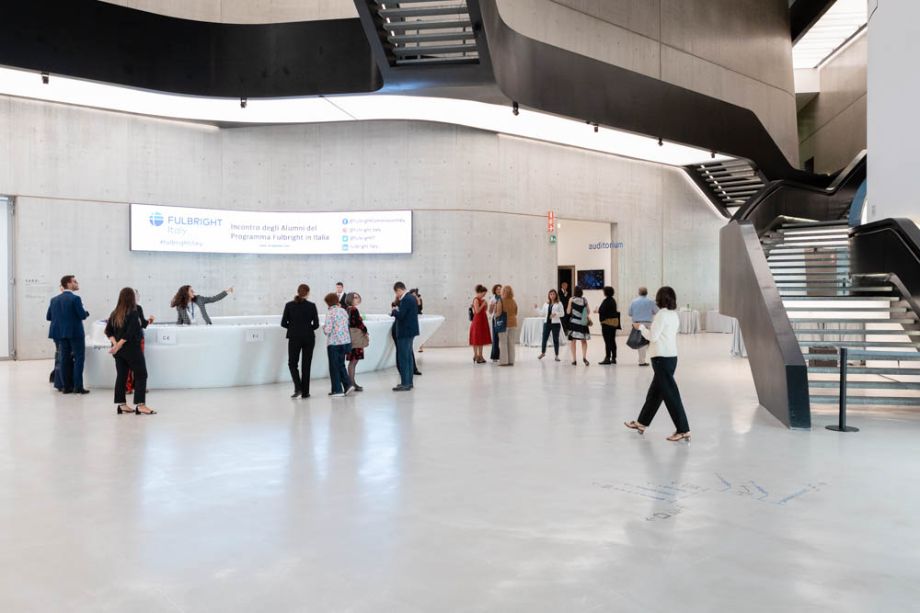
Fulbright Italy Alumni Meeting September 30, 2019, at Museum MAXXI in Rome
Visit our Scholar Directory to view and search all Fulbright alumni. You can also learn more about Fulbright Alumni Ambassadors.
Applicants for Teaching/Research Awards must submit a proposal outlining both the teaching and research components of the project.
Grantees will be required to live in the city where the host institution is located.