

Distinguished Scholar Fellowship
Israel
Number of recipients
In addition to being a prestigious academic exchange program, the Fulbright Program is designed to expand and strengthen relationships between the people of the United States and citizens of other nations and to promote international understanding and cooperation. To support this mission, Fulbright Scholars may be asked to give public talks, mentor students, and otherwise engage with the host community, in addition to their primary activities.
Fulbright Israel plans to award up to eight fellowships to senior faculty members, senior professionals, or to accomplished artists or writers for visits to Israeli institutions of higher education to be carried out during the 2027-28 academic year. The fellowship is open to all fields of study. Scholars’ proposed activities may include research, lecturing, or a combination of lecturing and research.
Per Fulbright Israel policy, candidates should take into account that host institutions are obliged to make a financial contribution of $2,000 to the United States-Israel Educational Foundation (USIEF), also known as Fulbright Israel, which is credited towards the overall grant benefits. The matter of this mandatory contribution should be raised in preliminary discussions with potential hosts and the commitment to provide the funds should be included in the letter of invitation.
Assistant Professor or higher academic rank (or equivalent professional standing) with at least seven years of experience in a discipline or area of expertise. is required.
Please contact the Fulbright program in Israel at USPrograms@fulbright.org.il for assistance with identifying suitable host contacts or any questions related to the financial commitment.
Any accredited institution of higher education. Visit Study in Israel for a complete list of such institutions.
Four months
Grants can begin between the period July 2027 - May 2028, as agreed upon with the host institution.
Applications are sought in all disciplines.
All applicants must meet the Program eligibility requirements (click to review the requirements).
A letter of invitation from an accredited Israeli institution of higher education is required at the time of application. Each candidate is responsible for the arrangement of his/her institutional affiliations in Israel independently, including development of the work program for the proposed visit through contacts with possible host institutions.
Per Fulbright Israel policy, host institutions are required to make a financial contribution of $2,000 to the United States-Israel Educational Foundation (USIEF), also known as Fulbright Israel, which is credited towards the overall grant benefits. The matter of this mandatory contribution should be raised in preliminary discussions with potential hosts and the commitment to provide the funds should be included in the letter of invitation.
Please contact the Fulbright program in Israel at USPrograms@fulbright.org.il for assistance with identifying suitable host contacts or any questions related to the financial commitment.
At least seven years of experience in a discipline or area of expertise by application deadline.
Assistant Professor or higher academic rank (or equivalent professional standing) is required.
For Tel Aviv University, Associate Professor or higher academic rank (or equivalent professional standing) is required. The Mortimer and Raymond Sackler Institute of Advanced Studies will be the official host of the fellow and the contact at the university, while the hosting academic unit is responsible for providing office and/or laboratory space.
- $6,000/month for unaccompanied grantees
- $6,500/month for grantees accompanied by one dependent
- $7,000/month for grantees accompanied by two or more dependents
Reimbursement of Travel expenses of up to $1,700 (U.S. – Israel, under the Fly America Act) for Fulbright fellows (and spouses).
Reimbursement of airfare expenses (U.S. – Israel, under the Fly America act) for spouse.
Partial reimbursement of education expenses and fees for up to two accompanying dependents in grades K-12.
Dependents must accompany the grantee for at least 80% of the period abroad and a minimum of one semester in order to qualify for additional dependent benefits. Dependent benefits are not provided to Flex grantees.
- Limited accident and medical coverage for the grantee only
- Fulbright Israel-sponsored arrival orientation
- Opportunities to participate in multiple cultural and academic events organized by Fulbright Israel
Final grant amounts will be determined prior to the start of the academic year and are subject to the availability of funds. The United States Department of State and the Fulbright Commission in the host country reserve the right to alter, without notice, participating countries, number of awards and allowances.
Israel
Israel’s higher education system is internationally recognized for its academic excellence, scientific influence, and strong global research connections. As of the 2024–2025 academic year, the country has 57 accredited institutions of higher education, including leading research universities and specialized academic colleges.
Israeli universities consistently appear in major global rankings. The Weizmann Institute of Science is ranked among the top 10 institutions worldwide for research quality in the Leiden Ranking and continues to rise in international standing. The Hebrew University of Jerusalem, founded in 1918 and one of the oldest universities in the region, is ranked around No. 81 in the Shanghai Academic Ranking of World Universities. The Technion Israel Institute of Technology, a cornerstone of Israel’s scientific and technological development, is similarly ranked among the top 100 universities globally.
Israel is widely known as the Start Up Nation, a recognition of its extraordinary entrepreneurial and technological ecosystem. Despite its small size, Israel has produced thousands of startups, many of which have become global leaders in fields such as cybersecurity, artificial intelligence, biotechnology, and clean energy. Breakthroughs originating in Israel have reshaped industries worldwide, fueling technological advancement and entrepreneurial activity on a scale that is remarkable for a country of its size.
Beyond its academic strengths, Israel provides a uniquely rich environment for geography, culture, and rich historical exploration. The country’s varied geography includes Mediterranean coastline, northern mountain ranges, and the Negev desert. As the birthplace of three major world religions, Israel contains an unparalleled concentration of historical, archaeological, cultural, and spiritual sites. Many scholars view Israel as a living laboratory for fields such as archaeology, history, international relations, environmental studies, technology policy, and innovation studies.
Fulbright scholars in Israel have the opportunity to collaborate with world-leading researchers, participate in cutting-edge academic work, and engage with one of the most dynamic intellectual landscapes in the world. The combination of outstanding research institutions, broad international partnerships, and exceptional cultural and historical depth makes Israel a compelling and rewarding destination for academic exchange.
Hear from some of our Alumni:
Rafael Deliz-Aguirre, Fulbright Postdoctoral Fellow 2024-2026, at Weizmann Institute of Science shared, "My research focuses on obtaining time from human tissues, where I explore molecular rhythms as a means for disease detection. The Weizmann is a top-notch institute full of brilliant people, and like my project, it has a mix of physics, chemistry, and biomedicine that has helped me think of the project in creative new ways while I adopt mass spectrometry, oscillations, and other physics analyses. Beyond the lab, I have been able to meet Israelis, learn the languages and local history, gain perspectives, and attend concerts from Chava Alberstein to David D’Or. The Fulbright Israel experience has shown me what true interdisciplinary research looks like while giving me a deeper understanding of the different cultures present in the State of Israel."
Alex (Eli) Pottash, Fulbright Postdoctoral Fellow 2023-2024, at Weizmann Institute of Science shared, "I spent 20 months at the Weizmann Institute of Science as a member of two talented groups. The facilities and infrastructure at the Institute were highly conducive to pursuing my research aims. The experience was not only beneficial for my professional development, but also thankfully led to satisfying work. Outside of the lab, I loved spending time in a young, resilient country, only a bus ride away from both Jerusalem and Tel Aviv. Fulbright Israel was a great resource while living here, and I will miss the staff and the community of visiting scholars they manage to continually build!"
Roie Levin, Fulbright Postdoctoral Fellow 2022-2023, at Tel Aviv University: "The Fulbright postdoctoral fellowship was an extraordinary experience. I had the chance to work with world experts in my field and to do so while living in Tel Aviv, one of the most vibrant and exciting cities in the world. I was extremely well-positioned to apply for academic positions after my program. The Fulbright staff was outstanding in every regard: they organized interdisciplinary workshops, planned cultural trips, and generally helped visiting scholars with the transition to living in Israel. I would be remiss not to mention how especially supportive they were in the chaotic aftermath of the October 7th attack."
Erika Tritle, Fulbright Postdoctoral Fellow 2018-2020, at Ben-Gurion University of the Negev indicated that "a postdoc in Israel combines access to world-class scholars and academic resources with the amazing experience of living in one of the most fascinating and historically rich regions of the world. My family and I have been grateful to meet so many people who are willing to invite us into their lives here. The Fulbright staff have helped at every stage with logistics, questions, connections, and providing opportunities to encounter Israel beyond the tourist’s surface."
Paul Sharp, Fulbright Postdoctoral Fellow 2021-2023 at The Hebrew University of Jerusalem, commented that, “My experience as a postdoc in Israel has exceeded my expectations. Working with unparalleled leaders in my field at Hebrew University, along with a welcoming and ambitious community of students, has created the conditions for my scientific creativity to reach new heights. I truly feel this is an inimitable training opportunity that positions me to attain a tenure-track position at a top department in the near future. Additionally, the Fulbright staff have been beyond supportive, making my transition to living in Israel a truly enjoyable experience."
The United States–Israel Educational Foundation (USIEF), also known as Fulbright Israel, was established in 1956 by the governments of the United States and Israel to administer the Fulbright Program in Israel. USIEF is funded by the United States and Israeli Governments and is governed by a binational Board of Directors. The Foundation aims to promote mutual understanding between the people of the United States and Israel by means of student and faculty exchanges at the highest possible level of academic excellence with around 40 Americans and 40 Israeli fellows per year.
Helpful links:
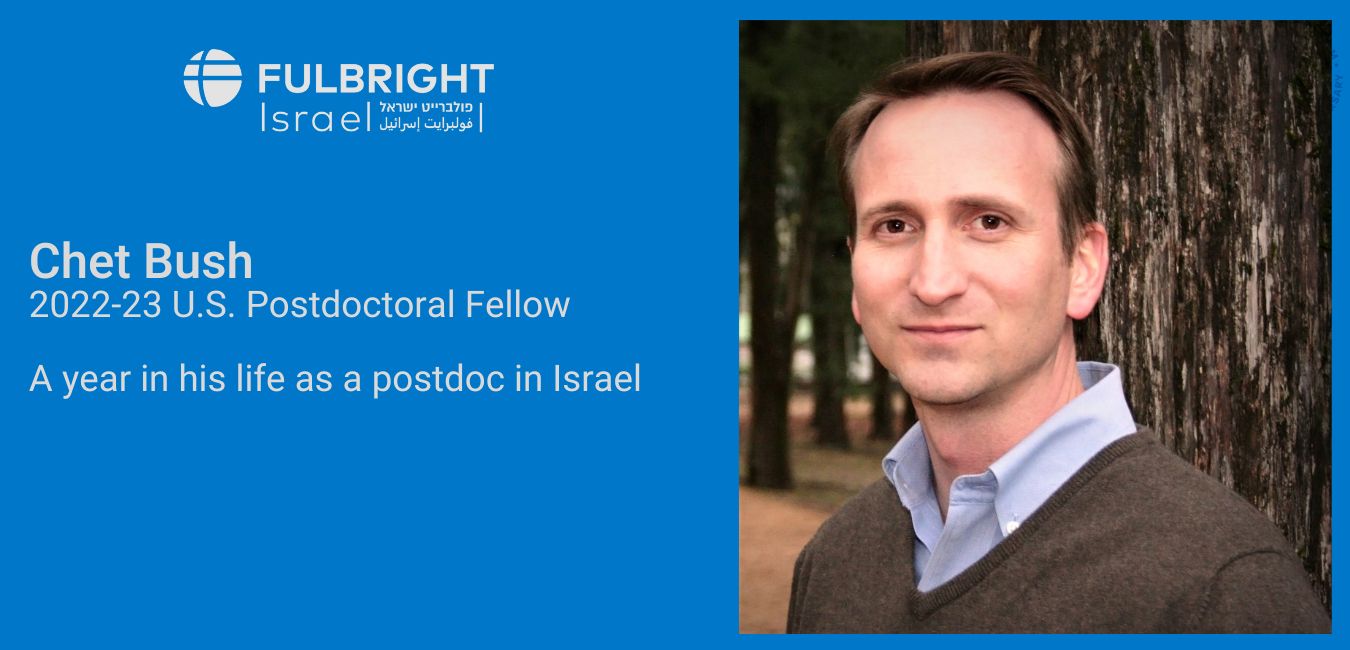
Chet Bush, a Fulbright alumnus to Israel, writes about his Fulbright experience in Israel and how it led me to reflect on life from several perspectives. Take a look at Dr. Chet Bush's journal featuring his Fulbright Israel Experience here.
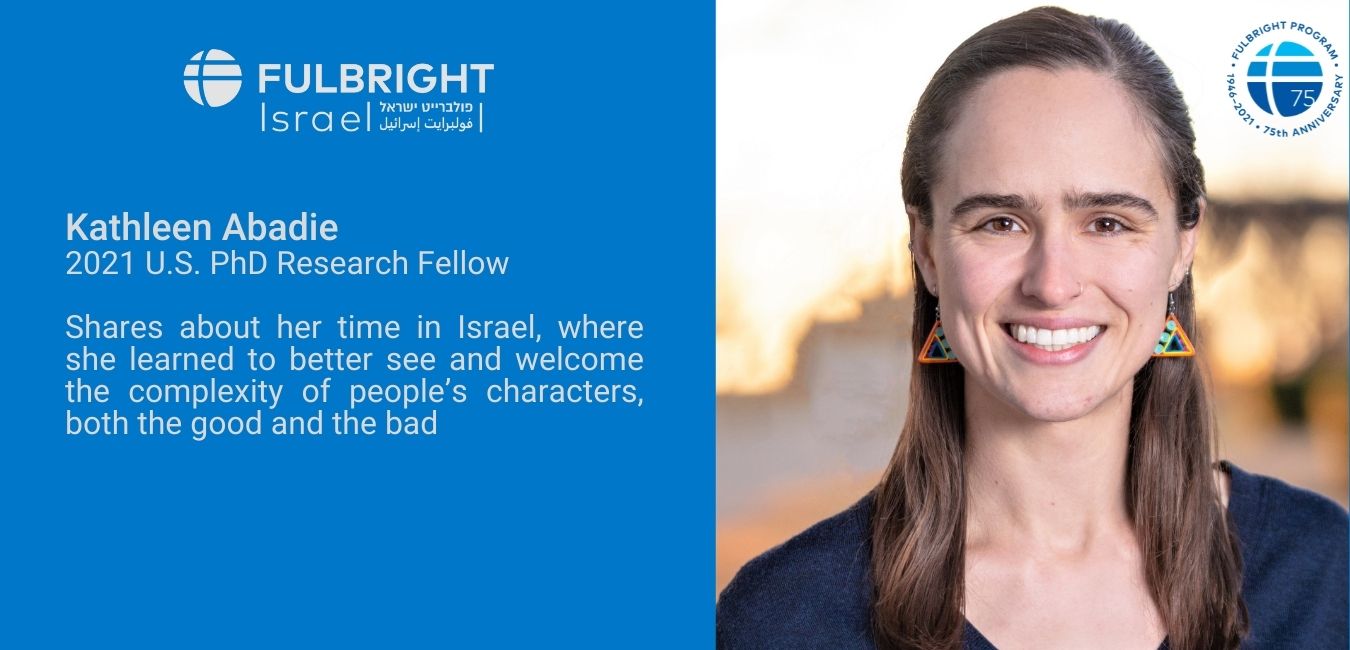
Kathleen Abadie, a Fulbright alumnus to Israel, shares her time in Israel, where she learned to better see and welcome the complexity of people’s characters. Read her story.
Visit our Scholar Directory to view and search all Fulbright alumni. You can also learn more about Fulbright Alumni Ambassadors.